


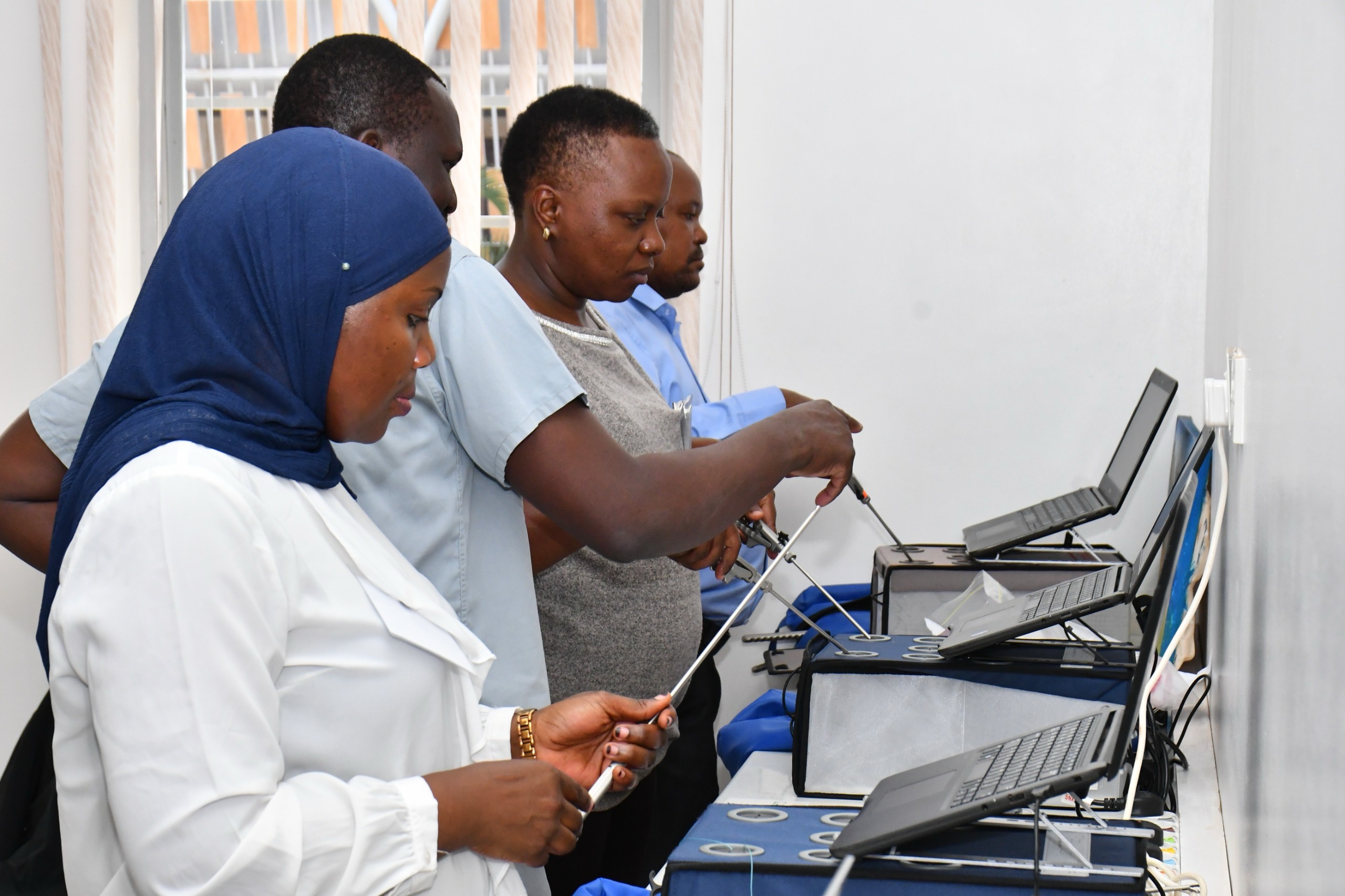

On a quiet training floor at Kyabirwa Surgical Centre in Jinja City, a group of doctors is learning to operate without making the large incisions traditionally associated with surgery.
Their operating theatre, for now, is a simulation laboratory.
The instruments are specialised, the procedures are carefully rehearsed and mistakes come without the consequences of a patient being on the operating table.
It is part of an effort to build Uganda’s capacity in laparoscopic surgery — commonly known as keyhole surgery — by equipping doctors with skills that could eventually take minimally invasive procedures beyond Kampala and a handful of private hospitals.
Sixteen lecturers from Makerere University’s Department of Obstetrics and Gynaecology are undergoing specialised training in the fundamentals of laparoscopic surgery at Kyabirwa Surgical Centre. They are joined by doctors from Gulu and Jinja Regional Referral Hospital.
The training began with virtual, self-paced theory sessions in July before participants moved to Kyabirwa this week for hands-on practice in the centre’s simulation laboratory. They will sit a practical examination at the end of the course.
Dr Joseph Okello Damoi, the head surgeon at Kyabirwa Surgical Centre, said the training is intended to give participants the foundation required before they begin practising laparoscopic surgery.
“World over, laparoscopic surgery has been proven as a safer, better method of delivering surgeries to patients for the procedures where it applies,” Dr Damoi said.
“This course teaches you the basics, what you need to know in order to be ready to practise laparoscopic surgery.”
Learning before the operating theatre
Unlike conventional surgery, laparoscopic procedures are performed through small openings using specialised instruments and a camera. The approach can reduce the size of surgical wounds and, in appropriate procedures, may allow patients to recover more quickly.
But introducing the technique requires more than buying equipment.
Doctors need specialised training, repeated practice and access to facilities where they can develop their skills safely.
At Kyabirwa, trainees use a simulation laboratory to practise the fundamentals before they operate on patients.
Samuel Banturaki, the simulation lab coordinator and Fundamentals of Laparoscopic Surgery proctor at the centre, said the model gives surgeons an opportunity to learn from their mistakes without putting patients at risk.
“Here they are in a position to learn in a risk-free environment where you are able to make all your errors before you ever step into the theatre,” he said.
The training is also expected to reduce the financial burden associated with obtaining specialised skills abroad.
Banturaki said that before Kyabirwa became an accredited training and testing centre, surgeons seeking similar training often had to travel overseas, incurring costs for flights, accommodation and other expenses.
The centre is accredited by the Society of American Gastrointestinal and Endoscopic Surgeons (SAGES), allowing it to provide training and administer certification examinations in Fundamentals of Laparoscopic Surgery.
Anna Kalumuna, executive director of Global Surgical Initiatives at Kyabirwa Surgical Centre, said the partnership with Makerere marks an important step in strengthening local surgical capacity.
“We have partnered with Makerere University, the Obstetrics and Gynaecology Department, to do a skills enhancement for the lecturers,” she said.
“At the end of the hands-on, we will administer the exam on behalf of SAGES and hopefully they will pass and can be certified in what we call Fundamentals of Laparoscopic Surgery. That certification is an internationally recognised certificate.”
From lecturers to the next generation
For Makerere University, however, the training is about more than certifying 16 doctors.
The lecturers are expected to become a bridge through which the skills can reach hundreds of medical students and postgraduate trainees who pass through the university.
Associate Professor Nakalembe Mariam, head of Makerere’s Department of Obstetrics and Gynaecology, said the partnership was deliberately designed around the university’s teaching role.
“Being people from the centre of training for medical students at undergraduate and postgraduate level, a lot of students pass through our hands,” she said.
“So as we keep passing on these skills, wherever they go, they will be able to pass on the skills.”
That ripple effect could prove important in a country where access to minimally invasive surgery remains uneven.
Nakalembe said Uganda has been slow to adopt minimal-access surgery, partly because of the cost involved and limited opportunities for specialised training.
Increasing the number of trained surgeons, she said, could help change that.
The Kampala concentration
For Dr Damoi, the challenge is not simply whether Uganda has laparoscopic surgeons, but where those surgeons are located.
“Most of the laparoscopic surgeons are found in Kampala. Maybe a number of the big private hospitals have laparoscopic surgeons,” he said.
“The public hospitals… I’m not sure if they have the services routinely running.”
The concentration means that the availability of minimally invasive surgery can depend on geography and the capacity of individual hospitals.
The Makerere training, he said, will help increase the number of doctors with the necessary skills while also creating an opportunity for those skills to spread through medical education.
“Definitely this will boost the number. But more than that, being gynaecology lecturers, it will have a ripple effect as they are able to teach it to their students,” he said.
Beyond the training room
The wider question is whether Uganda can create the infrastructure needed to make laparoscopic surgery routinely available.
Training doctors is one part of the equation. Hospitals also require appropriate equipment, maintenance, reliable supplies and personnel capable of supporting the procedures.
Dr Damoi wants the Government to develop a deliberate plan for scaling up the service, beginning with regional referral hospitals.
“The benefits of laparoscopic surgery are well known, well documented, well researched, and well published. So definitely the Government should come up with a plan to scale it up in the country,” he said.
He said regional referral hospitals should, at a minimum, be equipped to provide the service, with the possibility of eventually extending the capacity to district hospitals.
For patients, the appeal of laparoscopic surgery lies largely in what happens after the operation.
Kalumuna said the technique can mean smaller incisions, less bleeding, faster recovery, shorter hospital stays, earlier return to work and minimal scarring, depending on the procedure and patient.
Those advantages make the expansion of minimally invasive surgery particularly relevant in a health system where hospital resources are stretched and patients often face economic losses when illness keeps them away from work for extended periods.
Building a local training hub
Kyabirwa Surgical Centre has already trained surgeons from public and private hospitals and trainees under the College of Surgeons of East, Central and Southern Africa (COSECSA).
Another group of about 30 surgeons is expected to undertake a similar course at the centre in October.
The Makerere partnership is, however, the centre’s first formal collaboration of this kind with a university.
Officials say it could provide a foundation for further academic and professional training, including programmes in the fundamentals of endoscopy.
For now, the focus remains on the doctors in the simulation laboratory, mastering the basics before taking their skills into real operating theatres.
The larger ambition is clear: build expertise locally, expose the next generation of doctors to modern surgical techniques and gradually move laparoscopic surgery from a service concentrated in a few facilities to one that is accessible to more Ugandans.
For Makerere’s lecturers, the training may therefore be only the beginning. What they learn at Kyabirwa could eventually leave the simulation laboratory and travel with them into lecture rooms, hospitals and operating theatres across the country.

